

How To Prepare 1 N Ammonium Hydroxide Solution
| |||
| |||
| Names | |||
|---|---|---|---|
| IUPAC proper noun Ammonium hydroxide | |||
| Other names Ammonia water | |||
| Identifiers | |||
| CAS Number |
| ||
| 3D model (JSmol) |
| ||
| ChEBI |
| ||
| ChemSpider |
| ||
| ECHA InfoCard | 100.014.225 | ||
| EC Number |
| ||
| E number | E527 (acidity regulators, ...) | ||
| KEGG |
| ||
| PubChem CID |
| ||
| RTECS number |
| ||
| UNII |
| ||
| United nations number | 2672 | ||
| CompTox Dashboard (EPA) |
| ||
| InChI
| |||
| SMILES
| |||
| Properties[ane] | |||
| Chemical formula | NH3(aq) | ||
| Molar mass | 17.031 g/mol | ||
| Advent | Colourless liquid | ||
| Olfactory property | "Fishy", highly pungent | ||
| Density | 0.91 g/cm3 (25 % w/w) 0.88 thou/cm3 (35 % westward/w) | ||
| Melting point | −57.5 °C (−71.v °F; 215.7 Thou) (25 % w/due west) −91.5 °C (35% w/w) | ||
| Boiling point | 37.7 °C (99.9 °F; 310.8 Thou) (25 % w/westward) | ||
| Solubility in water | Miscible | ||
| Magnetic susceptibility (χ) | −31.v×10−6 cm3/mol | ||
| Thermochemistry | |||
| Std molar | 111 J/(mol·1000)[2] | ||
| Std enthalpy of | −fourscore kJ/mol[2] | ||
| Hazards[4] [v] | |||
| Occupational prophylactic and health (OHS/OSH): | |||
| Primary hazards | Moderately toxic | ||
| GHS labelling: | |||
| Pictograms |     | ||
| Betoken word | Danger | ||
| Take a chance statements | H302, H314, H335, H410 | ||
| Precautionary statements | P261, P271, P273, P280, P303+P361+P353, P305+P351+P338 | ||
| NFPA 704 (fire diamond) | 3 1 0 COR | ||
| Lethal dose or concentration (LD, LC): | |||
| LD50 (median dose) | 100 — 200 mg/kg[3] | ||
| Related compounds | |||
| Other anions | Ammonium chloride Ammonium cyanide | ||
| Other cations | Tetramethylammonium hydroxide | ||
| Related compounds | Ammonia Hydroxylamine | ||
| Except where otherwise noted, data are given for materials in their standard land (at 25 °C [77 °F], 100 kPa). Infobox references | |||


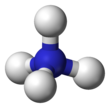


Ammonia solution, likewise known equally ammonia water, ammonium hydroxide, ammoniacal liquor, ammonia liquor, aqua ammonia, aqueous ammonia, or (inaccurately) ammonia, is a solution of ammonia in h2o. It can exist denoted by the symbols NH3(aq). Although the proper noun ammonium hydroxide suggests an alkali with composition [NH +
4 ][OH −
], it is actually impossible to isolate samples of NH4OH. The ions NH +
4 and OH− do not account for a pregnant fraction of the total corporeality of ammonia except in extremely dilute solutions.[6]
Basicity of ammonia in water [edit]
In aqueous solution, ammonia deprotonates a small fraction of the water to give ammonium and hydroxide according to the following equilibrium:
- NH3 + H2O
NH4 + + OH−.
In a 1 Thousand ammonia solution, about 0.42% of the ammonia is converted to ammonium, equivalent to pH = 11.63 considering [NH4 +] = 0.0042 M, [OH−] = 0.0042 M, [NH3] = 0.9958 One thousand, and pH = 14 + log10[OH−] = 11.62. The base of operations ionization constant is
- K b = [NHfour +][OH−] / [NH3] = 1.77×10−five.
Saturated solutions [edit]
Like other gases, ammonia exhibits decreasing solubility in solvent liquids as the temperature of the solvent increases. Ammonia solutions subtract in density as the concentration of dissolved ammonia increases. At 15.6 °C (60.ane °F), the density of a saturated solution is 0.88 yard/ml and contains 35.6% ammonia by mass, 308 grams of ammonia per litre of solution, and has a molarity of approximately 18 mol/L. At higher temperatures, the molarity of the saturated solution decreases and the density increases.[vii] Upon warming saturated solutions, ammonia gas is released.
Applications [edit]
In dissimilarity to anhydrous ammonia, aqueous ammonia finds few non-niche uses outside of cleaning agents.
Household cleaner [edit]
Diluted (1–iii%) ammonia is also an ingredient of numerous cleaning agents, including many window cleaning formulas.[viii] Because aqueous ammonia is a gas dissolved in water, as the water evaporates from a window, the gas evaporates also, leaving the window streak-free.
In addition to utilise as an ingredient in cleansers with other cleansing ingredients, ammonia in h2o is besides sold as a cleaning agent by itself, usually labeled as but "ammonia". Information technology may be sold plainly, lemon-scented (and typically colored yellow), or pine-scented (dark-green). Commonly available ammonia with soap added is known as "cloudy ammonia".
Alkyl amine precursor [edit]
In industry, aqueous ammonia can be used equally a precursor to some alkyl amines, although anhydrous ammonia is usually preferred. Hexamethylenetetramine forms readily from aqueous ammonia and formaldehyde. Ethylenediamine forms from 1,2-dichloroethane and aqueous ammonia.[9]
Absorption refrigeration [edit]
In the early years of the twentieth century, the vapor assimilation bicycle using water-ammonia systems was popular and widely used, but afterwards the evolution of the vapor pinch cycle it lost much of its importance because of its low coefficient of performance (well-nigh one 5th of that of the vapor compression cycle). Both the Electrolux refrigerator[10] and the Einstein refrigerator are well known examples of this application of the ammonia solution.
Water treatment [edit]
Ammonia is used to produce monochloramine, which is used as a disinfectant.[11] Chloramine is preferred over chlorination for its power to remain active in stagnant water pipes longer, reducing the risk of waterborne infections.
Ammonia is used by aquarists for the purposes of setting up a new fish tank using an ammonia procedure called fishless cycling.[12] This awarding requires that the ammonia contain no additives.
Food production [edit]
Baking ammonia (ammonium bicarbonate) was one of the original chemical leavening agents. It was obtained from deer antlers.[13] It is useful as a leavening agent, because ammonium carbonate is heat activated. This characteristic allows bakers to avoid both yeast's long proofing time and the quick COii dissipation of baking soda in making breads and cookies rise. It is withal used to make ammonia cookies and other crisp baked goods, but its popularity has waned because of ammonia's off-putting scent and concerns over its use every bit a food ingredient compared to modern-mean solar day baking powder formulations. It has been assigned Due east number E527 for apply every bit a food additive in the European Union.
Aqueous ammonia is used equally an acidity regulator to bring down the acrid levels in food. It is classified in the United States by the Food and Drug Administration as generally recognized equally safe (GRAS) when using the food course version.[14] Its pH control abilities brand information technology an effective antimicrobial agent.
Furniture concealment [edit]
In furniture-making, Ammonia fuming was traditionally used to darken or stain wood containing tannic acrid. After being sealed within a container with the wood, fumes from the ammonia solution react with the tannic acid and atomic number 26 salts naturally found in woods, creating a rich, dark stained wait to the wood. This technique was commonly used during the arts and crafts move in furniture – a furniture fashion which was primarily synthetic of oak and stained using these methods.[15]
Treatment of straw for cattle [edit]
Ammonia solution is used to treat straw, producing "ammoniated harbinger" making it more edible for cattle.[xvi]
Laboratory use [edit]
Aqueous ammonia is used in traditional qualitative inorganic analysis every bit a complexant and base of operations. Similar many amines, it gives a deep blue coloration with copper(II) solutions. Ammonia solution can dissolve silver oxide residues, such as that formed from Tollens' reagent. It is ofttimes found in solutions used to make clean gilt, argent, and platinum jewelry, only may have adverse effects on porous gem stones like opals and pearls.[17]
See also [edit]
- Ammonia
- Conjugate acid
References [edit]
- ^ Record of Ammonia solution in the GESTIS Substance Database of the Institute for Occupational Safety and Health .
- ^ a b Zumdahl, Steven S. (2009). Chemical Principles 6th Ed. Houghton Mifflin Company. p. A22. ISBN978-0-618-94690-7.
- ^ Ammonium hydroxide toxicity
- ^ C&L Inventory.
- ^ "GESTIS-Stoffdatenbank". gestis.dguv.de.
- ^ Housecroft, C. E.; Sharpe, A. G. (2004). Inorganic Chemistry (2d ed.). Prentice Hall. p. 187. ISBN978-0-13-039913-7.
- ^ Max Appl (2006). "Ammonia". Ammonia, in Ullmann'southward Encyclopedia of Industrial Chemistry. Weinheim: Wiley-VCH. doi:10.1002/14356007.a02_143.pub2. ISBN978-3527306732.
- ^ Christian Nitsch; Hans-Joachim Heitland; Horst Marsen; Hans-Joachim Schlüussler (2005). "Cleansing Agents". Ullmann'due south Encyclopedia of Industrial Chemistry. Weinheim: Wiley-VCH. doi:10.1002/14356007.a07_137. ISBN978-3527306732.
- ^ Eller, Karsten; Henkes, Erhard; Rossbacher, Roland; Höke, Hartmut (2000). "Amines, Aliphatic". Ullmann's Encyclopedia of Industrial Chemistry. doi:10.1002/14356007.a02_001. ISBN978-iii-527-30673-ii.
- ^ Vapour Assimilation Cycle - Domestic Electrolux Fridge
- ^ "Chloramines in Drinking H2o". EPA. US Ecology Protection Bureau. 20 Oct 2015. Retrieved 6 March 2018.
- ^ "Fishless Cycling". Aquarium Advice . Retrieved six March 2018.
- ^ Olver, Lynne (24 June 2012). "history notes—cookies, crackers & biscuits". The Nutrient Timeline. Archived from the original on 17 July 2012. Retrieved 6 January 2021.
- ^ Database of Select Committee on GRAS Substances (SCOGS) Reviews: Ammonium hydroxide, U.South. Food and Drug Assistants
- ^ Rigers, Shayne; Umney, Nick (12 August 2009). "Acidic and element of group i stains". Wood Coatings: Theory and Practice. Amsterdam: Elsevier. pp. 618–nine. ISBN978-0-444-52840-7.
- ^ "Is information technology Bedding or is information technology Feed? | Ohio Beefiness Cattle Letter".
- ^ The Jeweler's Demote. 2015. Fine Jewelry Cleaner. Littleton, Colo.
Further reading [edit]
- Geornaras, I.; Sofos, J. N. (2005). "Combining concrete and chemical decontamination interventions for meat". In Sofos, John Nikolaos (ed.). Improving the safety of fresh meat. Boca Raton: CRC Press. pp. 433–60. ISBN978-0-8493-3427-6.
- Skandamis, Panagiotis North.; Nychas, George-John E.; Sofos, John N. (2010). "Meat Decontamination". In Toldrá, Fidel (ed.). Handbook of Meat Processing. Ames: Iowa Land Academy Printing. pp. 43–85. doi:10.1002/9780813820897.ch3. ISBN978-0-8138-2089-7.
- Edwards, Jessica Renee; Fung, Daniel Y.C. (2006). "Prevention and Decontamination of Escherichia Coli O157:h7 on Raw Beef Carcasses in Commercial Beefiness Abattoirs". Journal of Rapid Methods and Automation in Microbiology. xiv (ane): i–95. doi:10.1111/j.1745-4581.2006.00037.x.
External links [edit]
- External Material Safety Information Sheet – for ammonium hydroxide (10%-35% solution).
Source: https://en.wikipedia.org/wiki/Ammonia_solution
0 Response to "How To Prepare 1 N Ammonium Hydroxide Solution"
Post a Comment