

Are Pandas Related To Raccoons
| Giant panda | |
|---|---|
 | |
| Giant panda at the Ocean Park Hong Kong | |
| Conservation condition | |
| | |
| CITES Appendix I (CITES)[one] | |
Scientific classification  | |
| Kingdom: | Animalia |
| Phylum: | Chordata |
| Class: | Mammalia |
| Order: | Carnivora |
| Family unit: | Ursidae |
| Genus: | Ailuropoda |
| Species: | A. melanoleuca |
| Binomial name | |
| Ailuropoda melanoleuca David, 1869[2] | |
| Subspecies | |
| |
 | |
| Behemothic panda range | |
| Giant panda | |||||||||||||||||||||||
|---|---|---|---|---|---|---|---|---|---|---|---|---|---|---|---|---|---|---|---|---|---|---|---|
 "Panda" in Traditional (peak) and Simplified (lesser) Chinese characters[three] | |||||||||||||||||||||||
| Traditional Chinese | 熊貓 | ||||||||||||||||||||||
| Simplified Chinese | 熊猫 | ||||||||||||||||||||||
| Literal meaning | "acquit cat" | ||||||||||||||||||||||
| |||||||||||||||||||||||
| Culling Chinese name | |||||||||||||||||||||||
| Traditional Chinese | 貓熊 | ||||||||||||||||||||||
| Simplified Chinese | 猫熊 | ||||||||||||||||||||||
| Literal meaning | "cat behave" | ||||||||||||||||||||||
| |||||||||||||||||||||||
The giant panda ( Ailuropoda melanoleuca ), also known every bit the panda bear (or simply the panda), is a bear species owned to Prc.[four] It is characterised by its bold blackness-and-white coat and rotund body. The name "giant panda" is sometimes used to distinguish it from the ruby-red panda, a neighboring musteloid. Though information technology belongs to the guild Carnivora, the behemothic panda is a folivore, with bamboo shoots and leaves making upwardly more than 99% of its diet.[5] Giant pandas in the wild occasionally swallow other grasses, wild tubers, or fifty-fifty meat in the form of birds, rodents, or feces. In captivity, they may receive dearest, eggs, fish, yams, shrub leaves, oranges, or bananas forth with specially prepared food.[half-dozen] [seven]
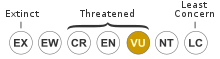
The giant panda lives in a few mount ranges in central China, mainly in Sichuan, and too in neighbouring Shaanxi and Gansu.[8] Equally a outcome of farming, deforestation, and other development, the giant panda has been driven out of the lowland areas where it once lived, and it is a conservation-reliant vulnerable species.[9] [ten] A 2007 study showed 239 pandas living in captivity inside Mainland china and another 27 exterior the land.[11] Past December 2014, 49 giant pandas lived in captivity exterior China, living in 18 zoos in 13 countries.[12] Wild population estimates vary; ane approximate shows that at that place are well-nigh 1,590 individuals living in the wild,[11] while a 2006 study via Deoxyribonucleic acid analysis estimated that this effigy could be equally high as two,000 to 3,000.[thirteen] Some reports likewise show that the number of giant pandas in the wild is on the ascent.[14] By March 2015, the wild behemothic panda population had increased to 1,864 individuals.[15] In 2016, information technology was reclassified on the IUCN Crimson Listing from "endangered" to "vulnerable",[i] affirming decade-long efforts to salvage the panda. In July 2021, Chinese regime also reclassified the giant panda as vulnerable.[16]
The giant panda has often served as Prc's national symbol, appeared on Chinese Gold Panda coins since 1982 and as i of the 5 Fuwa mascots of the 2008 Summer Olympics.
Taxonomy
Nomenclature
For many decades, the precise taxonomic classification of the giant panda was under debate because it shares characteristics with both bears and raccoons.[17] Withal, molecular studies indicate the giant panda is a true bear, office of the family Ursidae.[18] [xix] These studies show information technology diverged most xix million years ago from the common antecedent of the Ursidae;[20] it is the virtually basal member of this family and equidistant from all other extant acquit species.[21] [20] The giant panda has been referred to as a living fossil.[22]
Etymology
The discussion panda was borrowed into English from French, just no conclusive explanation of the origin of the French word panda has been found.[23] The closest candidate is the Nepali word ponya, possibly referring to the adapted wrist bone of the red panda, which is native to Nepal. The Western world originally applied this proper noun to the red panda.

In many older sources, the name "panda" or "common panda" refers to the lesser-known red panda,[24] thus necessitating the inclusion of "behemothic" and "lesser/carmine" prefixes in front end of the names. Even in 2013, the Encyclopædia Britannica still used "giant panda" or "panda conduct" for the carry,[25] and simply "panda" for the scarlet panda,[26] despite the popular usage of the give-and-take "panda" to refer to behemothic pandas.
Since the primeval collection of Chinese writings, the Chinese linguistic communication has given the behave twenty different names, such as mò ( 貘 ancient Chinese name for giant panda),[27] huāxióng ( 花熊 "spotted acquit") and zhúxióng ( 竹熊 "bamboo conduct").[28] The most popular names in People's republic of china today are dàxióngmāo ( 大熊貓 literally "giant behave cat"), or merely xióngmāo ( 熊貓 "carry cat"). The proper noun xióngmāo ( 熊貓 "comport cat") was originally used to describe the red panda (Ailurus fulgens), but since the behemothic panda was thought to be closely related to the crimson panda, dàxióngmāo ( 大熊貓 ) was named relatively.[28]
In Taiwan, another pop name for panda is the inverted dàmāoxióng ( 大貓熊 "giant true cat bear"), though many encyclopediae and dictionaries in Taiwan still apply the "bear true cat" class as the correct name. Some linguists debate, in this construction, "conduct" instead of "cat" is the base substantive, making this proper name more grammatically and logically right, which may take led to the popular selection despite official writings.[28] This name did not gain its popularity until 1988, when a private zoo in Tainan painted a sun behave blackness and white and created the Tainan fake panda incident.[29] [30]
Subspecies

Two subspecies of behemothic panda take been recognized on the ground of distinct cranial measurements, colour patterns, and population genetics.[31]
- The nominate subspecies, A. m. melanoleuca, consists of most extant populations of the giant panda. These animals are principally establish in Sichuan and display the typical stark blackness and white contrasting colours.
- The Qinling panda, A. chiliad. qinlingensis,[32] is restricted to the Qinling Mountains in Shaanxi at elevations of one,300–three,000 m (four,300–9,800 ft). The typical black and white design of Sichuan giant pandas is replaced with a lite brown and white pattern.[31] The skull of A. m. qinlingensis is smaller than its relatives, and it has larger molars.
A detailed study of the giant panda's genetic history from 2012[33] confirms that the separation of the Qinlin population occurred about 300,000 years agone, and reveals that the non-Qinlin population farther diverged into two groups, named the Minshan and the Qionglai-Daxiangling-Xiaoxiangling-Liangshan grouping respectively, about 2,800 years ago.[34]
Phylogeny
| Ursidae |
| ||||||

Description


Adults measure out around 1.2 to 1.9 metres (iii feet 11 inches to half-dozen anxiety 3 inches) long, including a tail of about 10–15 cm (four–6 in), and 60 to xc cm (24 to 35 in) tall at the shoulder.[36] [37] Males tin weigh upwards to 160 kg (350 lb).[38] Females (generally 10–xx% smaller than males)[39] can weigh equally piffling as 70 kg (150 lb), but can as well counterbalance up to 125 kg (276 lb).[9] [36] [xl] The average weight for adults is 100 to 115 kg (220 to 254 lb).[41]
The behemothic panda has a body shape typical of bears. Information technology has blackness fur on its ears, eye patches, limbs and shoulders. The residuum of the animal's coat is white.[42] The comport's distinctive coat appears to serve every bit camouflage in both winter and summertime environments. The white areas may serve as camouflage in snow, while the black shoulders and legs provide crypsis in shade.[43] Studies in the wild take establish that when viewed from a altitude, the panda displays disruptive coloration while shut up, they rely more on blending in.[44] The blackness ears may signal aggressive intent,[43] while the eye patches might facilitate them identifying one another.[43] [45] [46] The giant panda's thick, woolly coat keeps it warm in the cool forests of its habitat.[42] The panda'southward skull shape is typical of durophagous carnivorans. It has evolved from previous ancestors to exhibit larger molars with increased complexity and expanded temporal fossa.[47] [48] A 110.45 kg (243.five lb) giant panda has a 3D canine teeth bite force of 2603.47 newtons and bite force caliber of 292.[ citation needed ] Some other study had a 117.5 kg (259 lb) giant panda bite of 1298.9 newtons (BFQ 151.4) at canine teeth and 1815.9 newtons (BFQ 141.viii) at carnassial teeth.[49]

Bones of the left forelimb
The giant panda'southward mitt has a "pollex" and five fingers; the "pollex" – actually a modified sesamoid bone – helps it to agree bamboo while eating.[50] Stephen Jay Gould discusses this feature in his book of essays on evolution and biology, The Panda'due south Thumb.
The giant panda's tail, measuring 10 to 15 cm (4 to 6 in), is the second-longest in the bear family, behind the sloth bear.[39]
The giant panda typically lives around 20 years in the wild and up to 30 years in captivity.[51] A female named Jia Jia was the oldest giant panda ever in captivity, built-in in 1978 and died at an historic period of 38 on sixteen October 2016.[52]
Pathology
A vii-year-former female named Jin Yi died in 2014 in a zoo in Zhengzhou, Red china, after showing symptoms of gastroenteritis and respiratory disease. Information technology was establish that the crusade of decease was toxoplasmosis, a disease caused by an obligate intracellular parasitic protozoan known as Toxoplasma gondii that infects well-nigh warm-blooded animals, including humans.[53]
Genomics
The giant panda genome was sequenced in 2009 using Illumina dye sequencing.[54] Its genome contains 20 pairs of autosomes and one pair of sex chromosomes.
Ecology
Diet
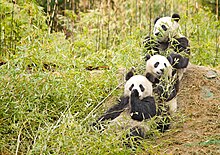
Pandas eating, standing, playing
Despite its taxonomic classification as a carnivoran, the giant panda's diet is primarily herbivorous, consisting almost exclusively of bamboo.[51] Even so, the behemothic panda however has the digestive system of a carnivore, as well as carnivore-specific genes,[55] and thus derives little energy and little protein from consumption of bamboo. The ability to break down cellulose and lignin is very weak, and their main source of nutrients comes from starch and hemicelluloses. The most important part of their bamboo diet is the shoots, that are rich in starch which they take a higher capability of digest than strict carnivores, and have upwardly till 32% protein content.[56] [57] [58] During the shoot season, which lasts from April to August, they put on a lot of weight, which allows them to get through the food-scarce period from late August to April, when they feed generally on bamboo leaves.[59] Pandas are built-in with sterile intestines and require bacteria obtained from their mother'south feces to digest vegetation.[60] The giant panda is a highly specialised animal with unique adaptations, and has lived in bamboo forests for millions of years.[61]
The average giant panda eats as much as 9 to 14 kg (twenty to 30 lb) of bamboo shoots a twenty-four hour period to recoup for the limited energy content of its diet. Ingestion of such a large quantity of cloth is possible and necessary considering of the rapid passage of large amounts of boxy institute fabric through the short, straight digestive tract.[62] [63] It is also noted, still, that such rapid passage of digesta limits the potential of microbial digestion in the gastrointestinal tract,[62] limiting alternative forms of digestion. Given this voluminous diet, the giant panda defecates upwardly to 40 times a day.[64] The limited energy input imposed on information technology by its diet has affected the panda's behavior. The behemothic panda tends to limit its social interactions and avoids steeply sloping terrain to limit its energy expenditures.[65]
It has been estimated that an developed panda absorbs 54.viii–66.1 mg of cyanide a day through its diet. To prevent poisoning, they have evolved anti-toxic mechanisms to protect themselves. About 80% of the cyanide is metabolized to less toxic thiocyanate and discharged in urine, while the remaining xx% is detoxified by other minor pathways.[66]
2 of the panda'south almost distinctive features, its large size and circular face, are adaptations to its bamboo nutrition. Anthropologist Russell Ciochon observed: "[much] similar the vegetarian gorilla, the depression torso surface area to torso book [of the giant panda] is indicative of a lower metabolic charge per unit. This lower metabolic rate and a more sedentary lifestyle allows the giant panda to subsist on nutrient poor resources such as bamboo."[65] Similarly, the behemothic panda's round face is the outcome of powerful jaw muscles, which attach from the top of the caput to the jaw.[65] Large molars crush and grind fibrous plant fabric.
The morphological characteristics of extinct relatives of the giant panda propose that while the ancient giant panda was omnivorous vii million years ago (mya), it only became herbivorous some two–2.iv mya with the emergence of A. microta.[67] [68] Genome sequencing of the giant panda suggests that the dietary switch could have initiated from the loss of the sole T1R1/T1R3 umami taste receptor, resulting from 2 frameshift mutations inside the T1R1 exons.[69] Umami gustation corresponds to high levels of glutamate equally found in meat and may take thus altered the food pick of the behemothic panda.[seventy] Although the pseudogenisation of the umami taste receptor in Ailuropoda coincides with the dietary switch to herbivory, it is likely a result of, and not the reason for, the dietary alter.[68] [69] [lxx] The mutation time for the T1R1 gene in the behemothic panda is estimated to 4.2 mya[68] while fossil evidence indicates bamboo consumption in the giant panda species at least 7 mya,[67] signifying that although consummate herbivory occurred effectually 2 mya, the dietary switch was initiated prior to T1R1 loss-of-office.
Pandas eat whatever of 25 bamboo species in the wild, such as Fargesia dracocephala [71] and Fargesia rufa.[72] Simply a few bamboo species are widespread at the loftier altitudes pandas at present inhabit. Bamboo leaves contain the highest protein levels; stems accept less.[73]
Considering of the synchronous flowering, death, and regeneration of all bamboo within a species, the behemothic panda must have at least ii different species available in its range to avoid starvation. While primarily herbivorous, the behemothic panda still retains decidedly ursine teeth and volition swallow meat, fish, and eggs when available. In captivity, zoos typically maintain the giant panda's bamboo diet, though some will provide peculiarly formulated biscuits or other dietary supplements.[74]
Pandas will travel betwixt different habitats if they need to, so they can get the nutrients that they demand and to rest their diet for reproduction. For half-dozen years, scientists studied six pandas tagged with GPS collars at the Foping Reserve in the Qinling Mountains. They took note of their foraging and mating habits and analyzed samples of their food and feces. The pandas would move from the valleys into the Qinling Mountains and would but return to the valleys in fall. During the summer months, bamboo shoots rich in protein are merely available at college altitudes which causes low calcium rates in the pandas. During breeding flavour, the pandas would render to lower altitudes to eat bamboo leaves rich in calcium.[75]
Predators
Although developed behemothic pandas have few natural predators other than humans, young cubs are vulnerable to attacks past snow leopards, yellow-throated martens,[76] eagles, feral dogs, and the Asian black deport. Sub-adults weighing up to fifty kg (110 lb) may exist vulnerable to predation by leopards.[77]
Behavior
The giant panda is a terrestrial animal and primarily spends its life roaming and feeding in the bamboo forests of the Qinling Mountains and in the hilly province of Sichuan.[78] Behemothic pandas are generally solitary.[61] Each adult has a defined territory and a female is not tolerant of other females in her range. Social encounters occur primarily during the brief breeding flavour in which pandas in proximity to one another will gather.[79] After mating, the male leaves the female alone to raise the cub.[80]
Pandas were idea to fall into the crepuscular category, those who are agile twice a day, at dawn and dusk; however, Jindong Zhang plant that pandas may belong to a category all of their ain, with activity peaks in the morning, afternoon and midnight. The low nutrition quality of bamboo means pandas demand to eat more than frequently, and due to their lack of major predators they can be agile at whatever time of the mean solar day.[81] Activity is highest in June and decreases in late summer to autumn with an increase from Nov through the following March.[82] Activity is besides directly related to the amount of sunlight during colder days.[82]
Pandas communicate through vocalisation and scent marker such as clawing trees or spraying urine.[nine] They are able to climb and take shelter in hollow copse or stone crevices, but do not institute permanent dens. For this reason, pandas do not hibernate, which is similar to other subtropical mammals, and will instead move to elevations with warmer temperatures.[83] Pandas rely primarily on spatial memory rather than visual retention.[84]
Though the panda is often causeless to be docile, it has been known to attack humans, presumably out of irritation rather than aggression.[85] [86] [87]
Pandas take been known to cover themselves in horse manure to protect themselves against cold temperatures.[88]
Reproduction
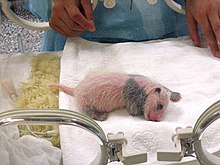
A giant panda cub. At nativity, the behemothic panda typically weighs 100 to 200 grams (iii+ one⁄2 to seven ounces) and measures fifteen to 17 centimeters (six to 7 inches) long.[89]
Initially, the principal method of convenance behemothic pandas in captivity was by artificial insemination, as they seemed to lose their interest in mating one time they were captured.[90] This led some scientists to endeavor extreme methods, such as showing them videos of giant pandas mating[91] and giving the males sildenafil (commonly known every bit Viagra).[92] Merely recently have researchers started having success with captive convenance programs, and they have now determined giant pandas accept comparable breeding to some populations of the American blackness comport, a thriving bear species. The normal reproductive rate is considered to be 1 young every ii years.[14] [78]
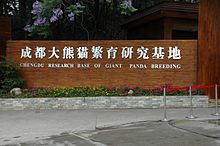
Panda Inquiry and Breeding Eye in Chengdu.
Behemothic pandas attain sexual maturity between the ages of four and viii, and may be reproductive until age 20.[93] The mating flavor is betwixt March and May, when a female goes into estrus, which lasts for two or 3 days and only occurs once a year.[94] When mating, the female is in a crouching, caput-down position as the male mounts her from backside. Copulation fourth dimension ranges from xxx seconds to five minutes, simply the male may mount her repeatedly to ensure successful fertilisation. The gestation period is somewhere between 95 and 160 days - the variability is due to the fact that the fertilized egg may linger in the reproductive arrangement for a while before implanting on the uterine wall.[94]
Giant pandas give birth to twins in almost half of pregnancies.[95] If twins are born, usually only one survives in the wild. The mother volition select the stronger of the cubs, and the weaker cub will die due to starvation. The mother is idea to be unable to produce enough milk for two cubs since she does not shop fatty.[96] The father has no part in helping raise the cub.
When the cub is first born, it is pink, blind, and toothless,[97] weighing only xc to 130 g (3+ 1⁄4 to four+ 1⁄2 oz), or about 1 / 800 of the female parent's weight,[17] proportionally the smallest babe of whatsoever placental mammal.[98] It nurses from its mother's breast six to 14 times a twenty-four hours for up to 30 minutes at a time. For three to iv hours, the mother may leave the den to feed, which leaves the cub defenseless. Ane to two weeks afterwards birth, the cub'due south peel turns grey where its pilus volition eventually become black. Slight pinkish color may appear on the cub's fur, equally a issue of a chemical reaction between the fur and its female parent's saliva. A month after birth, the colour design of the cub's fur is fully developed. Its fur is very soft and coarsens with historic period. The cub begins to crawl at 75 to fourscore days;[17] mothers play with their cubs by rolling and wrestling with them. The cubs can eat small quantities of bamboo subsequently half-dozen months,[99] though mother'southward milk remains the primary food source for most of the offset year. Giant panda cubs counterbalance 45 kg (100 pounds) at one yr and live with their mothers until they are 18 months to two years old. The interval between births in the wild is more often than not two years.
In July 2009, Chinese scientists confirmed the birth of the first cub to be successfully conceived through artificial insemination using frozen sperm.[100] The cub was born at 07:41 on 23 July that year in Sichuan as the third cub of You You lot, an 11-twelvemonth-quondam.[100] [101] [102] The technique for freezing the sperm in liquid nitrogen was get-go developed in 1980 and the offset birth was hailed as a solution to the dwindling availability of behemothic panda semen, which had led to inbreeding.[102] [103] Panda semen, which tin can be frozen for decades, could exist shared between unlike zoos to save the species.[100] [101] It is expected that zoos in destinations such every bit San Diego in the Usa and Mexico City will now be able to provide their own semen to inseminate more than behemothic pandas.[103] In August 2014, a rare birth of panda triplets was announced in Communist china; information technology was the fourth of such births e'er reported.[104]
Attempts have also been made to reproduce giant pandas by interspecific pregnancy where cloned panda embryos were implanted into the uterus of an fauna of some other species. This has resulted in panda fetuses, but no alive births.[105]
Man use and interaction
Early references
In the past, pandas were thought to be rare and noble creatures – the Empress Dowager Bo was cached with a panda skull in her vault. The grandson of Emperor Taizong of Tang is said to take given Japan two pandas and a sheet of panda skin as a sign of goodwill. Unlike many other animals in Ancient Prc, pandas were rarely thought to have medical uses. The few known uses include the Sichuan tribal peoples' utilize of panda urine to melt accidentally swallowed needles, and the employ of panda pelts to control menstruum as described in the Qin dynasty encyclopedia Erya.[106]
The brute named mo (貘) mentioned in some ancient books has been interpreted as behemothic panda.[106] The dictionary Shuowen Jiezi (Eastern Han Dynasty) says that the mo, from Shu (Sichuan), is bear-like, but yellow-and-blackness,[107] although the older Erya describes mo merely equally a "white leopard".[108] The interpretation of the legendary fierce creature pixiu (貔貅) as referring to the behemothic panda is likewise common.[109]
During the reign of the Yongle Emperor (early 15th century), his relative from Kaifeng sent him a captured zouyu (騶虞), and another zouyu was sighted in Shandong. Zouyu is a legendary "righteous" fauna, which, similarly to a qilin, only appears during the rule of a chivalrous and sincere monarch. Information technology is said to be vehement as a tiger, just gentle and strictly vegetarian, and described in some books equally a white tiger with black spots. Puzzled about the real zoological identity of the creature captured during the Yongle era, Dutch Sinologist J. J. L. Duyvendak exclaimed, "Tin it possibly have been a Pandah?"[110]
Western discovery
The W first learned of the giant panda on eleven March 1869, when the French missionary Armand David[17] received a skin from a hunter. The outset Westerner known to take seen a living giant panda is the German zoologist Hugo Weigold, who purchased a cub in 1916. Kermit and Theodore Roosevelt, Jr., became the first Westerners to shoot a panda, on an trek funded past the Field Museum of Natural History in the 1920s. In 1936, Ruth Harkness became the outset Westerner to bring back a live giant panda, a cub named Su Lin[111] who went to alive at the Brookfield Zoo in Chicago. In 1938, Floyd Tangier Smith captured and delivered five behemothic pandas to London, they arrived on 23 December aboard the SS Antenor.[112] [113] These five were the first on British soil and were transferred to London Zoo.[114] One, named Grandma, only lasted a few days. She was taxidermized by E. Gerrard and Sons and sold to Leeds City Museum where she is currently on display to the public. Another, Ming, became London Zoo's first Giant Panda. Her skull is held by the Royal College of Surgeons of England.[115]
Panda diplomacy

In the 1970s, gifts of giant pandas to American and Japanese zoos formed an important office of the diplomacy of the People'south Republic of China (Prc), as information technology marked some of the starting time cultural exchanges between China and the W. This practice has been termed "panda diplomacy".[116]
Past 1984, however, pandas were no longer given as gifts. Instead, China began to offering pandas to other nations only on x-yr loans, under terms including a fee of up to United states of america$ane,000,000 per twelvemonth and a provision that whatsoever cubs born during the loan are the belongings of Prc. Since 1998, because of a WWF lawsuit, the United States Fish and Wild fauna Service but allows a U.s.a. zoo to import a panda if the zoo can ensure that People's republic of china will channel more than than half of its loan fee into conservation efforts for the giant panda and its habitat. As a result of this change in policy, nearly all the pandas in the world are owned by China. The pandas leased to strange zoos and any cubs are eventually returned to China.[117] [118]
In May 2005, Communist china offered a breeding pair to Taiwan. The outcome became embroiled in cantankerous-Strait relations – both over the underlying symbolism, and over technical problems such every bit whether the transfer would be considered "domestic" or "international", or whether any true conservation purpose would be served past the exchange.[119] A competition in 2006 to name the pandas was held in the mainland, resulting in the politically charged names Tuan Tuan and Yuan Yuan (from tuanyuan, significant "reunion", i.e. "reunification"). People's republic of china'southward offering was initially rejected by Chen Shui-bian, then President of Taiwan. Withal, when Ma Ying-jeou assumed the presidency in 2008, the offer was accustomed, and the pandas arrived in December of that year.[120]
Zoos
Pandas have been kept in zoos as early every bit the Western Han Dynasty in China, where the writer Sima Xiangru noted that the panda was the most treasured animal in the emperor's garden of exotic animals in the capital letter Chang'an (nowadays 11'an). Not until the 1950s were pandas once again recorded to accept been exhibited in China'south zoos.[121]
Chi Chi at the London Zoo became very pop. This influenced the Globe Wildlife Fund to employ a panda as its symbol.[122]
A 2006 New York Times article outlined the economics of keeping pandas,[123] which costs 5 times more than keeping the next most expensive animal, an elephant. American zoos more often than not pay the Chinese authorities $one million a yr in fees, as part of a typical x-year contract. San Diego'south contract with People's republic of china was to elapse in 2008, only got a v-yr extension at about half of the previous yearly toll.[124] The last contract, with the Memphis Zoo in Memphis, Tennessee, ended in 2013.[123]
Conservation
The giant panda is a vulnerable species, threatened past continued habitat loss and habitat fragmentation,[125] and by a very low birthrate, both in the wild and in captivity.[51] Its range is currently bars to a pocket-size portion on the western edge of its historical range, which stretched through southern and eastern China, northern Myanmar, and northern Vietnam.[one]
The giant panda has been a target of poaching by locals since aboriginal times and by foreigners since it was introduced to the West. Starting in the 1930s, foreigners were unable to poach behemothic pandas in Cathay because of the 2nd Sino-Japanese State of war and the Chinese Civil War, but pandas remained a source of soft furs for the locals. The population boom in People's republic of china subsequently 1949 created stress on the pandas' habitat and the subsequent famines led to the increased hunting of wildlife, including pandas. During the Cultural Revolution, all studies and conservation activities on the pandas were stopped. Afterwards the Chinese economic reform, demand for panda skins from Hong Kong and Japan led to illegal poaching for the black marketplace, acts generally ignored by the local officials at the time.

Closeup of a vii-calendar month-old panda cub
In 1963, the People's republic of china government set up Wolong National Nature Reserve to save the declining panda population.[126] However, few advances in the conservation of pandas were fabricated at the time, attributable to inexperience and insufficient knowledge of ecology. Many believed the best mode to relieve the pandas was to cage them. Because of the devastation of their natural habitat, along with segregation caused by caging, reproduction of wild pandas was severely express. In the 1990s, even so, several laws (including gun control and the removal of resident humans from the reserves) helped their chances of survival. With these renewed efforts and improved conservation methods, wild pandas take started to increase in numbers in some areas, though they however are classified as a rare species. [ citation needed ]
In 2006, scientists reported that the number of pandas living in the wild may have been underestimated at well-nigh 1,000. Previous population surveys had used conventional methods to judge the size of the wild panda population, just using a new method that analyzes Deoxyribonucleic acid from panda droppings, scientists believe the wild population may be as large every bit iii,000.[51] In 2006, there were xl panda reserves in Prc, compared to just 13 reserves in 1998.[13] Every bit the species has been reclassified to "vulnerable" since 2016, the conservation efforts are thought to be working. Furthermore, in response to this reclassification, the State Forestry Administration of Mainland china announced that they would non appropriately lower the conservation level for panda, and would instead reinforce the conservation efforts.[127]
The giant panda is among the world's most adored and protected rare animals, and is i of the few in the world whose natural inhabitant status was able to proceeds a UNESCO World Heritage Site designation. The Sichuan Behemothic Panda Sanctuaries, located in the southwest province of Sichuan and roofing 7 natural reserves, were inscribed onto the World Heritage Listing in 2006.[128] [129] [130]
Not all conservationists concur that the money spent on conserving pandas is well spent. Chris Packham has argued that the breeding of pandas in captivity is "pointless" because "in that location is not enough habitat left to sustain them".[131] Packham argues that the money spent on pandas would be better spent elsewhere,[131] and has said he would "eat the last panda if I could accept all the coin we have spent on panda conservation put back on the table for me to do more sensible things with". He as well quoted, "The panda is perhaps one of the grossest wastes of conservation money in the last half century",[132] though he has apologised for upsetting people who like pandas.[133] However, a 2015 paper found that the giant panda can serve every bit an umbrella species as the preservation of their habitat also helps other owned species in China, including lxx% of the country'due south forest birds, 70% of mammals and 31% of amphibians.[134]
In 2012, Earthwatch Plant, a global nonprofit that teams volunteers with scientists to acquit important environmental research, launched a programme called "On the Trail of Giant Panda". This program, based in the Wolong National Nature Reserve, allows volunteers to work upward shut with pandas cared for in captivity, and help them conform to life in the wild, and so that they may breed, and live longer and healthier lives.[135] Efforts to preserve the panda bear populations in People's republic of china accept come at the expense of other animals in the region, including snow leopards, wolves, and dholes.[136]
In order to improve living and mating weather for the fragmented populations of pandas, virtually lxx natural reserves have been combined to grade the Giant Panda National Park in 2020. With a size of 10,500 foursquare miles, the park is roughly three times as large every bit Yellowstone National Park and incorporates the Wolong National Nature Reserve. The state-endemic Bank of Cathay helped to enable the project with U.s.$1.5 billion. 1 major aim is to permanently keep the panda population stable enough to avoid a relapse to its erstwhile IUCN Red List "endangered" status. Especially small, isolated populations run the risk of inbreeding and smaller genetic variety makes the individuals more vulnerable to diverse defects and genetic mutation. Allowing a larger grouping of individuals to roam through a larger surface area freely and choose from a greater variety of mates, helps to enrich genetic diversity of their offspring.[137]
In 2020, the panda population of the new national park was already above 1,800 individuals, which is roughly fourscore percentage of the entire panda population in China. Establishing the new protected expanse in the Sichuan Province also gives various other endangered or threatened species, similar the Siberian tiger, the possibility to amend their living conditions by offering them a habitat.[138] Other species who benefit from the protection of their habitat include the snow leopard, the golden snub-nosed monkey, the red panda and the circuitous-toothed flying squirrel.
In July 2021, Chinese conservation authorities announced that behemothic pandas are no longer endangered in the wild following years of conservation efforts, with a population in the wild exceeding 1,800.[139] [140]
Biofuel
Microbes in panda waste are existence investigated for their employ in creating biofuels from bamboo and other plant materials.[141]
Population chart
| Year | Wild[142] | Modify | Captivity[61] | Modify | Total | Alter |
|---|---|---|---|---|---|---|
| 1976 | 1,000 | north/a | n/a | n/a | n/a | n/a |
| 1985 | 800–i,200 | n/a | n/a | n/a | n/a | n/a |
| 1987 | >1,000 | n/a | due north/a | due north/a | north/a | n/a |
| 1994 | one,200 | north/a | n/a | northward/a | n/a | north/a |
| 1995 | 1,000 | −200 | due north/a | n/a | n/a | north/a |
| 2003 | 1,596 | +596 | 164[143] | n/a | 1,760 | north/a |
| 2012 | n/a | n/a | 341[144] | +178 | n/a | n/a |
| 2013 | ane,864[145] | +268 | 375[143] [146] | +34[146] | ii,239 | +479 |
See also
- Behemothic pandas around the world
- Listing of giant pandas
- Panda tea
- Pygmy giant panda
- Wildlife of Cathay
- List of endangered and protected species of China
References
- Notes
- ^ a b c d Swaisgood, R.; Wang, D. & Wei, F. (2017) [errata version of 2016 cess]. "Ailuropoda melanoleuca". IUCN Red List of Threatened Species. 2016: e.T712A121745669. Retrieved fifteen January 2022.
- ^ David, A. (1869). "Voyage en Chine". Message des Nouvelles Archives du Muséum. 5: 13.
- ^ Like the English "giant", the term dà ("big") is technically prefixed to the name "panda" in Chinese, simply is not generally in everyday use.
- ^ Scheff, Duncan (2002). Giant Pandas. Animals of the rain wood (illustrated ed.). Heinemann-Raintree Library. p. 7. ISBN0-7398-5529-viii.
- ^ Quote: "Bamboo forms 99 percent of a panda's nutrition", "more than 99 percent of their nutrition is bamboo": p. 63 of Lumpkin & Seidensticker 2007 (as seen in the 2002 edition).
- ^ "Behemothic Panda". Discovery Communications, LLC. Archived from the original on 7 Jan 2010. Retrieved viii August 2010.
- ^ "Giant Pandas". National Zoological Park. Archived from the original on iii June 2010. Retrieved 7 Nov 2010.
- ^ Scheff, D. (2002). Giant Pandas. Animals of the rain forest (illustrated ed.). Heinemann-Raintree Library. p. 8. ISBN0-7398-5529-8.
- ^ a b c "Global Species Programme – Behemothic panda". World Wild fauna Fund. fourteen November 2007. Archived from the original on 4 July 2008. Retrieved 22 July 2008.
- ^ "Four out of half-dozen great apes one step away from extinction – IUCN Red List". 4 September 2016. Archived from the original on 8 September 2016. Retrieved 4 September 2016.
- ^ a b "Number of pandas successfully bred in Red china downward from terminal year". Xinhua News Agency. 8 Nov 2007. Archived from the original on 23 July 2008. Retrieved 22 July 2008.
- ^ "Panda Zoos Around The World". GiantPandaZoo.com. Archived from the original on 2 January 2016.
- ^ a b Briggs, Helen (20 June 2006). "Promise for future of giant panda". BBC News. Archived from the original on 27 Jan 2007. Retrieved xiv Feb 2007.
- ^ a b W., Lynne (July 2006). "Pandas, Inc". National Geographic Magazine . Retrieved ten April 2008.
- ^ "Behemothic panda population rises by nearly 17 percent". Mongabay Environmental News. 2 March 2015. Archived from the original on 2 April 2015. Retrieved 3 March 2015.
- ^ "Giant pandas no longer endangered in the wild, China announces". the Guardian. 2021. Archived from the original on nine July 2021. Retrieved 9 July 2021.
- ^ a b c d "Giant Panda". Encyclopædia Britannica Online. 2010. Archived from the original on 15 May 2013. Retrieved ix August 2010.
- ^ Lindburg, Donald Grand.; Baragona, Karen (2004). Giant Pandas: Biological science and Conservation. Academy of California Press. ISBN0-520-23867-two.
- ^ O'Brien, S.J.; Nash, W.K.; Wildt, D.E.; Bush, Yard.E. & Benveniste, R.Due east. (1985). "A molecular solution to the riddle of the giant panda's phylogeny". Nature. 317 (6033): 140–144. Bibcode:1985Natur.317..140O. doi:ten.1038/317140a0. PMID 4033795. S2CID 4352629.
- ^ a b Krause, J.; Unger, T.; Noçon, A.; Malaspinas, A.; Kolokotronis, Southward.; Stiller, Grand.; Soibelzon, L.; Spriggs, H.; Dearest, P. H.; Briggs, A. W.; Bray, S. C. Eastward.; O'Brien, S. J.; Rabeder, G.; Matheus, P.; Cooper, A.; Slatkin, M.; Pääbo, S. & Hofreiter, M. (2008). "Mitochondrial genomes reveal an explosive radiation of extinct and extant bears almost the Miocene-Pliocene boundary". BMC Evolutionary Biology. viii (220): 220. doi:10.1186/1471-2148-8-220. PMC2518930. PMID 18662376.
- ^ Yu, L.; Li, Y.i-W.; Ryder, O. A.; Zhang, Y.-P. (2007). "Analysis of complete mitochondrial genome sequences increases phylogenetic resolution of bears (Ursidae), a mammalian family that experienced rapid speciation". BMC Evolutionary Biology. 7 (198): 198. doi:10.1186/1471-2148-vii-198. PMC2151078. PMID 17956639.
- ^ "Backside the News – Panda Granny". Australian Dissemination Corporation. 2007. Archived from the original on 4 May 2008. Retrieved 22 July 2008.
- ^ Oxford English Dictionary, s.v. panda northward. 1.
- ^ "Animal Info – Cherry Panda". Archived from the original on ane September 2008. Retrieved 4 August 2009.
- ^ "giant panda (mammal) – Encyclopedia Britannica". Britannica.com. Archived from the original on 15 May 2013. Retrieved 23 January 2017.
- ^ "panda (mammal, Ailurus species) – Encyclopedia Britannica". Britannica.com. Archived from the original on 15 May 2013. Retrieved 23 January 2017.
- ^ Harper, Donald (2013), "The Cultural History of the Giant Panda (Ailuropoda melanoleuca) in Early Prc", Early China 35/36: 185-224. (abstract)
- ^ a b c "Discussion almost the Chinese name for giant panda (in Chinese)". Archived from the original on 24 January 2008. Retrieved 17 January 2008.
- ^ "Authorities Data Office volition now employ dàxióngmāo as the proper proper name (in Chinese)". 聯合報. nine August 1990.
- ^ ""bear cat" or "cat bear" (in Chinese)". 聯合報. 29 December 1987. Archived from the original on 3 September 2015. Retrieved 31 March 2015.
- ^ a b Wan, Wu & Fang 2005.
- ^ Hammond, Paula (2010). The Atlas of Endangered Animals: Wild fauna Under Threat Around the Globe. Marshall Cavendish. p. 58. ISBN978-0-7614-7872-0.
- ^ Shancen Zhao; Pingping Zheng; Shanshan Dong; Xiangjiang Zhan; Qi Wu (16 December 2012). "Whole-genome sequencing of giant pandas provides insights into demographic history and local accommodation". Nature Genetics. 45 (i): 67–71. doi:10.1038/ng.2494. PMID 23242367. S2CID 1261505.
- ^ "Scientists Discover Evidence of Giant Panda's Population History and Local Adaptation". xvi December 2012. Archived from the original on 18 December 2012. Retrieved 17 December 2012.
- ^ "Search the Segmentation of Mammals Collections". Smithsonian National Museum of Natural History. Retrieved 15 May 2022.
- ^ a b Giant Panda, Arkive, archived from the original on 23 Dec 2014
- ^ "Physical Clarification". Behemothic Panda Species Survival Plan. Archived from the original on 4 Dec 2011. Retrieved 26 Oct 2011.
- ^ Boitani, Luigi (1984). Simon & Schuster'southward Guide to Mammals. Simon & Schuster / Touchstone Books. ISBN978-0-671-42805-1. Archived from the original on four December 2021. Retrieved 27 September 2020.
- ^ a b Brown, Gary (1996). Great Carry Almanac . The Lyons Press. p. 340. ISBNi-55821-474-seven.
- ^ "Archived copy" (PDF). 2011. Archived from the original (PDF) on 24 September 2015. Retrieved 5 February 2016.
{{cite web}}: CS1 maint: archived re-create as title (link) - ^ "Giant panda Ailuropoda melanoleuca". Brute Fact Guide. 2011. Archived from the original on 14 September 2011. Retrieved 19 September 2011.
- ^ a b Dudley, Karen (1997). Giant Pandas. Untamed earth (Illustrated ed.). Weigl Educational Publishers Express. p. 9. ISBN0-919879-87-10.
- ^ a b c Caro, T.; et al. (2017). "Why is the giant panda blackness and white?". Behavioral Ecology. 28 (3): 657–667. doi:10.1093/beheco/arx008.
- ^ Nokelainen, Ossi; Scott-Samuel, Nicholas E.; Nie, Yonggang; Wei, Fuwen; Caro, Tim (2021). "The giant panda is cryptic". Scientific Reports. 11 (21287): 21287. Bibcode:2021NatSR..1121287N. doi:10.1038/s41598-021-00742-4. PMC8553760. PMID 34711890.
- ^ Morell, Virginia (1 March 2017). "How pandas got their patches". Science. American Association for the Advancement of Science (AAAS). doi:x.1126/science.aal0840. ISSN 0036-8075.
- ^ Wang, Le; Ding, Rizhi; Zhai, Yuanhao; Zhang, Qilin; Tang, Wei; Zheng, Nanning; Hua, Gang (2021). "Giant Panda Identification" (PDF). IEEE Transactions on Image Processing. Establish of Electrical and Electronics Engineers (IEEE). 30: 2837–2849. Bibcode:2021ITIP...30.2837W. doi:10.1109/tip.2021.3055627. ISSN 1057-7149. PMID 33539294. S2CID 231818504. Archived (PDF) from the original on 20 April 2021. Retrieved 8 February 2021.
- ^ Ellis, Richard (2004). No turning dorsum: the life and death of animate being species (illustrated ed.). HarperCollins. p. 315. ISBN0-06-055803-ii.
- ^ Figueirido, Borja; Zhijie Jack Tseng, Alberto Mart ́ın-Serra (July 2013). "Skull shape evolution in durophagous carnivorans". Evolution; International Journal of Organic Evolution. 67 (7): 1975–93. doi:ten.1111/evo.12059. PMID 23815654. S2CID 23918004.
- ^ Christiansen, Per; Wroe, Stephen (2007). "Bite forces and evolutionary adaptations to feeding ecology in carnivores". Ecology. 88 (two): 347–358. doi:10.1890/0012-9658(2007)88[347:BFAEAT]2.0.CO;2. PMID 17479753. Archived from the original on 4 Dec 2021. Retrieved 3 November 2017.
- ^ Morris, Paul; Susan F. Morris. "The Panda's Thumb". Athro Limited. Archived from the original on 8 Nov 2020. Retrieved 7 Baronial 2010.
- ^ a b c d Earth'south Irresolute Environment . Learn & Explore. Encyclopædia Britannica, Inc. 2010. p. 49. ISBN978-1-61535-339-2.
- ^ "'Oldest' panda in captivity Jia Jia dies at the age of 38". BBC. 16 October 2016. Archived from the original on 16 October 2016. Retrieved sixteen October 2016.
- ^ Ma, Hongyu; Wang, Zedong; Wang, Chengdong; Li, Caiwu; Wei, Feng; Liu, Quan (2015). "Fatal Toxoplasma gondii infection in the giant panda". Parasite. 22: thirty. doi:ten.1051/parasite/2015030. ISSN 1776-1042. PMC4626621. PMID 26514595.
- ^ Li, R.; Fan, Due west.; Tian, Chiliad.; Zhu, H.; He, 50.; Cai, J.; Huang, Q.; Cai, Q.; Li, B.; Bai, Y.; Zhang, Z.; Zhang, Y.; Wang, W.; Li, J.; Wei, F.; Li, H.; Jian, M.; Li, J.; Zhang, Z.; Nielsen, R.; Li, D.; Gu, W.; Yang, Z.; Xuan, Z.; Ryder, O. A.; Leung, F. C. C.; Zhou, Y.; Cao, J.; Sun, X.; et al. (2009). "The sequence and de novo assembly of the giant panda genome". Nature. 463 (7279): 311–317. Bibcode:2010Natur.463..311L. doi:10.1038/nature08696. PMC3951497. PMID 20010809.
- ^ "(...)indicating that the panda probably has all the necessary components for a carnivorous digestive system." Li R, Fan W, Tian G, Zhu H, He L, Cai J, Huang Q, Cai Q, Li B, Bai Y, Zhang Z, Zhang Y, Wang Due west, Li J, Wei F, Li H, Jian M, Li J, Zhang Z, Nielsen R, Li D, Gu W, Yang Z, Xuan Z, Ryder OA, Leung FC, Zhou Y, Cao J, Dominicus X, et al. (2010). "The sequence and de novo assembly of the giant panda genome". Nature. 463 (21): 311–317. Bibcode:2010Natur.463..311L. doi:ten.1038/nature08696. PMC3951497. PMID 20010809.
- ^ Age-associated microbiome shows the behemothic panda lives on hemicelluloses, not on cellulose - Nature
- ^ Bamboo Is Basically 'Fake Meat' for Giant Pandas | Smart News
- ^ Written report sheds lite on giant panda diet - Chinadaily.com.cn
- ^ Pandas' Gut Bacteria May Help Them Fatten Up While Eating Bamboo | Technology Networks
- ^ "BBC Nature — Dung eater videos, news and facts". Bbc.co.uk. Archived from the original on 29 December 2011. Retrieved 27 November 2011.
- ^ a b c "Giant Panda Facts". nationalzoo.si.edu. National Zoological Park. Archived from the original on 23 June 2012. Retrieved viii June 2012.
- ^ a b Dierenfeld, Due east. Due south.; Hintz, H. F.; Robertson, J. B.; Van Soest, P. J.; Oftedal, O. T. (1982). "Utilization of bamboo by the behemothic panda". Journal of Nutrition. 112 (four): 636–641. doi:ten.1093/jn/112.4.636. PMID 6279804.
- ^ Finley, T. G.; Sikes, Robert S.; Parsons, Jennifer L.; Rude, Brian J.; Bissell, Heidi A.; Ouellette, John R. (2011). "Energy digestibility of giant pandas on bamboo-just and on supplemented nutrition". Zoo Biology. thirty (2): 121–133. doi:10.1002/zoo.20340. PMID 20814990.
- ^ "Panda tests bring population promise". BBC. 20 June 2006. Archived from the original on 26 March 2012. Retrieved 28 October 2010.
- ^ a b c Ciochon, Russell L.; Eaves-Johnson, K. Lindsay (20 July 2007). "Bamboozled! The Curious Natural History of the Giant Panda Family unit". Scitizen. Archived from the original on 21 July 2007. Retrieved 22 July 2008.
- ^ Dietary resources shape the adaptive changes of cyanide detoxification part in giant panda (Ailuropoda melanoleuca) - Nature
- ^ a b Jin, C; Ciochon, R. L.; Dong, W; Chase Jr, R. M.; Liu, J; Jaeger, M; Zhu, Q (2007). "The first skull of the earliest giant panda". Proceedings of the National Academy of Sciences of the United States of America. 104 (26): 10932–10937. Bibcode:2007PNAS..10410932J. doi:10.1073/pnas.0704198104. PMC1904166. PMID 17578912.
- ^ a b c Zhao, S; Zheng, P; Dong, S; Zhan, X; Wu, Q; Guo, 10; Hu, Y; He, W; Zhang, S; Fan, W; Zhu, Fifty; Li, D; Zhang, X; Chen, Q; Zhang, H; Zhang, Z; Jin, X; Zhang, J; Yang, H; Wang, J; Wang, J; Wei, F (2013). "Whole-genome sequencing of giant pandas provides insights into demographic history and local accommodation". Nature Genetics. 45 (one): 67–71. doi:x.1038/ng.2494. PMID 23242367. S2CID 1261505.
- ^ a b Li, R; Fan, W; Tian, One thousand; Zhu, H; He, 50; Cai, J; Huang, Q; Cai, Q; Li, B; Bai, Y; Zhang, Z; Zhang, Y; Wang, W; Li, J; Wei, F; Li, H; Jian, M; Li, J; Zhang, Z; Nielsen, R; Li, D; Gu, W; Yang, Z; Xuan, Z; Ryder, O. A.; Leung, F. C.; Zhou, Y; Cao, J; Sun, 10; et al. (2010). "The sequence and de novo assembly of the behemothic panda genome". Nature. 463 (7279): 311–317. Bibcode:2010Natur.463..311L. doi:10.1038/nature08696. PMC3951497. PMID 20010809.
- ^ a b Jin, K; Xue, Chenyi; Wu, Xiaoli; Qian, Jinyi; Zhu, Yong; Yang, Zhen; Yonezawa, Takahiro; Crabbe, M. James C.; Cao, Ying; Hasegawa, Masami; Zhong, Yang; Zheng, Yufang (2011). "Why does the behemothic panda eat bamboo? A comparative analysis of appetite-reward-related genes amid mammals". PLOS 1. half-dozen (seven): 22602. Bibcode:2011PLoSO...622602J. doi:x.1371/periodical.pone.0022602. PMC3144909. PMID 21818345.
- ^ Li, De-Zhu; Guo, Zhenhua; Stapleton, Chris (2007). "Fargesia dracocephala". In Wu, Z. Y.; Raven, P.H.; Hong, D.Y. (eds.). Flora of Prc. Vol. 22. Beijing: Scientific discipline Printing; St. Louis: Missouri Botanical Garden Press. p. 93. Archived from the original on 9 January 2012. Retrieved 7 November 2007.
- ^ Li, De-Zhu; Guo, Zhenhua; Stapleton, Chris (2007). "Fargesia rufa". In Wu, Z. Y.; Raven, P.H.; Hong, D.Y. (eds.). Flora of China. Vol. 22. Beijing: Science Press; St. Louis: Missouri Botanical Garden Press. p. 81. Archived from the original on 10 November 2016. Retrieved 7 November 2007.
- ^ Dolberg, Frands (1 August 1992). "Progress in the utilization of urea-ammonia treated crop residues: biological and socio-economic aspects of animal production and application of the technology on small farms". University of Arhus. Archived from the original on 7 July 2011. Retrieved ten August 2010.
- ^ Lumpkin & Seidensticker 2007, pp. 63–64 (page numbers as per the 2002 edition)
- ^ "Pandas roam to find better bamboo". Australian Geographic. 25 July 2014. Archived from the original on 11 November 2014. Retrieved 17 November 2014.
- ^ "Predator of giant panda". WWF. Archived from the original on 1 December 2017. Retrieved 22 November 2017.
- ^ Schaller, G.B., Jinchu, H., Wenshi, P., and Jing, Z. (1985). The giant pandas of Wolong. Chicago and London: University of Chicago Press.
{{cite book}}: CS1 maint: multiple names: authors list (link) - ^ a b "Panda behavior & habitat". World Wildlife Federation People's republic of china. Archived from the original on 7 June 2008. Retrieved 16 June 2008.
- ^ "Giant Panda". National Zoological Park. Archived from the original on 17 July 2008. Retrieved 17 July 2008.
- ^ Dudley, Karen (1997). Giant Pandas. Untamed world (illustrated ed.). Weigl Educational Publishers. p. 23. ISBN0-919879-87-X.
- ^ Pandas Live by a Dissimilar Rhythm Archived fifteen August 2015 at the Wayback Machine published on 8 July 2015 by Michigan State Univ.
- ^ a b Zhang, Jindong; Hull, Vanessa; Huang, Jinyang; Zhou, Shiqiang (24 Nov 2015). "Activity patterns of the behemothic panda (Ailuropoda melanoleuca)". Periodical of Mammalogy. 96 (6): 1116–1127. doi:10.1093/jmammal/gyv118. Archived from the original on 29 March 2020. Retrieved 8 March 2020.
- ^ Paul Massicot (thirteen February 2007). "Animal Info – Behemothic Panda". Animal Info. Archived from the original on 7 June 2008. Retrieved 17 June 2008.
- ^ Deborah Smith Bailey (January 2004). "Understanding the behemothic panda". American Psychological Association. Archived from the original on fourteen June 2008. Retrieved 17 June 2008.
- ^ "Teenager hospitalized afterward panda assail in Chinese zoo". Flim-flam News/Associated Press. 23 October 2007. Archived from the original on 9 June 2009. Retrieved 29 July 2008.
- ^ "Panda attacks man in Chinese zoo". BBC News. 22 November 2008. Archived from the original on 27 June 2009. Retrieved 3 September 2009.
- ^ "Giant panda in Communist china bites third victim". CNN News. 10 January 2009. Archived from the original on 18 January 2009. Retrieved 10 January 2009.
- ^ Zhou, Wenliang; Yang, Shilong; Li, Bowen; Nie, Yonggang; Luo, Anna; Huang, Guangping; Liu, Xuefeng; Lai, Ren; Wei, Fuwen (2 Dec 2020). "Why wild giant pandas often coil in equus caballus manure". Proceedings of the National Academy of Sciences. 117 (51): 32493–32498. Bibcode:2020PNAS..11732493Z. doi:x.1073/pnas.2004640117. ISSN 0027-8424. PMC7768701. PMID 33288697.
- ^ "Animate being Info – Behemothic Panda". Archived from the original on xiv March 2009. Retrieved 29 May 2009.
- ^ "National Zoo's Behemothic Panda Undergoes Artificial Insemination". NBC. Associated Printing. 19 March 2008. Retrieved 13 April 2008. [ permanent dead link ]
- ^ Prapanya, Narunart (25 January 2006). "'Panda porn' to encourage mating". Time Warner. Archived from the original on 5 April 2008. Retrieved 13 April 2008.
- ^ "Pandas unexcited past Viagra". BBC News. ix September 2002. Archived from the original on 5 Oct 2007. Retrieved xiii April 2008.
- ^ "Giant Panda Reproduction" (PDF). National Zoological Park. Archived from the original (PDF) on 27 May 2008. Retrieved 13 April 2008.
- ^ a b Kleiman, Devra G. "Behemothic Panda Reproduction". Archived from the original on 7 August 2008. Retrieved 14 Apr 2008.
- ^ Ruane, Michael E.; Koh, Elizabeth; Weil, Martin (23 August 2015). "National Zoo's behemothic panda Mei Xiang gives birth to ii cubs hours apart". The Washington Post. Archived from the original on 24 August 2015. Retrieved 24 August 2015.
- ^ "Panda Facts". Pandas International. Archived from the original on 24 September 2015. Retrieved 26 August 2015.
- ^ Dudley, Karen (1997). Giant Pandas. Untamed world (Illustrated ed.). Weigl Educational Publishers. p. 26. ISBN0-919879-87-X.
- ^ Guinness Globe Records 2013, Page 050, hardcover edition. ISBN 9781904994879
- ^ "Panda Update: September Cub Examination". Discovery Communications, LLC. 4 May 2006. Archived from the original on 7 Nov 2010. Retrieved 9 August 2010.
- ^ a b c "Baby panda born from frozen sperm". BBC. 25 July 2009. Archived from the original on 26 July 2009. Retrieved 26 July 2009.
- ^ a b "Globe's 1st giant panda built-in from frozen sperm in SW China". Xinhua News Bureau. 24 July 2009. Archived from the original on 26 December 2009. Retrieved 26 July 2009.
- ^ a b "First panda cub built-in using frozen sperm". The Irish Times. 25 July 2009. Archived from the original on 16 October 2011. Retrieved 26 July 2009.
- ^ a b Tran, Tini (24 July 2009). "China announces get-go panda from frozen sperm". USA TODAY. Archived from the original on 23 June 2011. Retrieved 24 Jan 2011.
- ^ "Rare panda triplets built-in in Cathay". cbc.ca. 12 August 2014. Archived from the original on 14 August 2014. Retrieved 12 August 2014.
- ^ Chen, D. Y.; Wen, D. C.; Zhang, Y. P.; Sun, Q. Y.; Han, Z. M.; Liu, Z. H.; Shi, P.; Li, J. S.; Xiangyu, J. 1000.; Lian, L.; Kou, Z. H.; Wu, Y. Q.; Chen, Y. C.; Wang, P. Y.; Zhang, H. Thou. (2002). "Interspecies implantation and mitochondria fate of panda-rabbit cloned embryos". Biology of Reproduction. 67 (two): 637–642. doi:ten.1095/biolreprod67.2.637. PMID 12135908.
- ^ a b Schaller 1993, p. 61
- ^ Shuowen Jiezi, Chapter ten, radical 豸: "貘:似熊而黃黑色,出蜀中" ("Mo: like carry, but yellow-and-black, comes from Shu").
- ^ Erya, Affiliate "釋獸" ("Near animals") Archived iv December 2021 at the Wayback Machine: "貘,白豹" (Mo, white leopard).
- ^ Cathay Giant Panda Museum: Historical Records in Ancient China Archived six July 2012 at the Wayback Machine. Supposed Chinese historical terminology appears in the Chinese version of this article, 我国古代的历史记载 Archived 6 July 2012 at the Wayback Automobile
- ^ Duyvendak, J.J.L. (1939). "The True Dates of the Chinese Maritime Expeditions in the Early on Fifteenth Century The True Dates of the Chinese Maritime Expeditions in the Early Fifteenth Century". T'oung Pao. 2d Series. 34 (v): 402. JSTOR 4527170.
- ^ Watson, DA. "The Panda Lady: Ruth Harkness (Role 1)". Female explorers. Archived from the original on xv December 2006. Retrieved i February 2007.
- ^ "Behemothic Pandas Through Singapore. Rare Animals from Wilds of China. Will be Start to Reach Europe in Captivity". The Straits Times. 27 Nov 1938. Archived from the original on 26 July 2011. Retrieved 2 Feb 2010.
- ^ Austin, A. B. (8 January 1939). "How Giant Pandas Arrived in London". The Straits Times. Archived from the original on 26 July 2011. Retrieved ii February 2010.
- ^ Nicholls, Henry (2010). The Style of the Panda: The Curious History of China's Political Animal. Pegasus Books.
- ^ Hussey, Kristin (2014). "Ming the forgotten celebrity: a giant panda skull at the Imperial Higher of Surgeons of England". Archives of Natural History. 41 (1): 159–175. doi:10.3366/anh.2014.0219 – via ACADEMIA.
- ^ Buckingham, Kathleen Carmel; David, Jonathan Neil William; Jepson, Paul (September 2013). "Environmental Reviews and Case Studies: Diplomats and Refugees: Panda Diplomacy, Soft "Cuddly" Power, and the New Trajectory in Panda Conservation". Environmental Practise. 15 (3): 262–270. doi:10.1017/S1466046613000185. ISSN 1466-0466. S2CID 154378167. Archived from the original on 11 Apr 2020. Retrieved 18 January 2020.
- ^ "In memory of panda queen nicknamed "Granny Basi," five amazing things you may not know virtually pandas". Newsweek. 16 September 2017. Retrieved 3 June 2022.
- ^ Fikes, Bradely (25 March 2019). "Terminal pandas at San Diego Zoo are leaving". San Diego Wedlock-Tribune . Retrieved iii June 2022.
- ^ Cathay's Panda Politics. Newsweek. xv October 2007. Retrieved 23 May 2008. Archived 10 October 2012 at the Wayback Machine
- ^ Mainland china sends panda peace offering Archived 27 September 2016 at the Wayback Machine. The Guardian. 28 December 2008.
- ^ Schaller pg.62.
- ^ "Giant Panda: Overview". Globe Wildlife Fund. Archived from the original on 9 Baronial 2012. Retrieved 26 Oct 2011.
- ^ a b Goodman, Brenda (12 Feb 2006). "Eats Shoots, Leaves and Much of Zoos' Budgets". The New York Times. Atlanta. Archived from the original on 23 June 2011. Retrieved nine August 2010.
- ^ "Zoo negotiates lower price to rent bears from China". SignOnSanDiego.com. 13 December 2008. Archived from the original on sixteen February 2009. Retrieved 23 May 2009.
- ^ Li, Renqiang; Xu, Ming; Wong, Michelle Hang Gi (February 2015). "Climate change threatens giant panda protection in the 21st century". Biological Conservation. 182: 93–101. doi:x.1016/j.biocon.2014.11.037. Archived from the original on 27 December 2019. Retrieved 10 July 2019.
- ^ "Almost Wolong". Wolong National Natural Reserve. 7 May 2005. Archived from the original on 1 December 2006.
- ^ The Panda is still endangered species, and the conservation efforts nonetheless demand to be reinforced Archived 13 September 2016 at the Wayback Automobile State Forestry Administration of the People's Commonwealth of People's republic of china (in Chinese)
- ^ "Pandas gain world heritage status". BBC. 12 July 2006. Archived from the original on 25 Jan 2020. Retrieved 17 January 2020.
- ^ Benn, Joanna (13 July 2006). "Panda sanctuary in Prc added to World Heritage list". WWF. Archived from the original on 1 August 2020. Retrieved 17 January 2020.
- ^ "Sichuan Giant Panda Sanctuaries – Wolong, Mt Siguniang and Jiajin Mountains". Unesco WHC. Archived from the original on 29 Jan 2020. Retrieved 17 January 2020.
- ^ a b Chris Packham: 'Giant pandas should be allowed to dice out'. The Daily Telegraph. 22 September 2009.
- ^ Beyond beautiful and cuddly Archived 16 January 2009 at the Wayback Car. The Australian. 10 November 2007.
- ^ "Goggle box Packham says sorry for 'ditch pandas' blast". Daily Mirror. UK. 23 September 2009. Archived from the original on 29 Dec 2009. Retrieved 24 April 2010.
- ^ Pimm, Stuart L.; Li, Binbin 5. (2015). "China'due south endemic vertebrates sheltering under the protective umbrella of the behemothic panda". Conservation Biology. 30 (2): 329–339. doi:ten.1111/cobi.12618. PMID 26332026. S2CID 34750531.
- ^ "Earthwatch: On the Trail of Giant Panda". Archived from the original on 1 March 2012. Retrieved 24 February 2012.
- ^ Jessie Yeung (4 August 2020). "China's focus on panda conservation has come up at the cost of other species: study". CNN. Archived from the original on 13 Baronial 2020. Retrieved 16 Baronial 2020.
- ^ "Communist china'due south National Panda Park Will Be Three Times the Size of Yellowstone". Archived from the original on xix Apr 2021. Retrieved 31 March 2021.
- ^ "Cathay forges ahead with ambitious national park programme". National Geographic Society. 27 August 2020. Archived from the original on three March 2021. Retrieved 31 March 2021.
- ^ "Behemothic pandas no longer endangered in the wild, Prc announces". TheGuardian.com. 9 July 2021. Archived from the original on 11 July 2021. Retrieved 11 July 2021.
- ^ "Conservation efforts accept saved China's giant pandas from the endangered species listing". CBS News. Archived from the original on 11 July 2021. Retrieved xi July 2021.
- ^ "Panda Poop Might Assist Turn Plants into Fuel". News.nationalgeographic.com. ten September 2013. Archived from the original on 18 September 2013. Retrieved 2 Oct 2013.
- ^ "Creature Info – Behemothic Panda". www.animalinfo.org. Archived from the original on 23 September 2015. Retrieved two September 2015.
- ^ a b Davison, Nicola (28 February 2015). "Red china's panda population increases past 17 per cent, major census finds". Archived from the original on 3 September 2015. Retrieved 2 September 2015.
- ^ Brooks, Melody. "Summary – Giant Panda (Ailuropoda melanoleuca) Fact Sheet, 2001 – ResearchGuides at International Environment Library Consortium". ielc.libguides.com. Archived from the original on 3 September 2015. Retrieved two September 2015.
- ^ "How many are left in the wild?". wwf.panda.org. Archived from the original on 5 September 2015. Retrieved two September 2015.
- ^ a b "Panda Demography 2013 | Wild Panda Population Increases to one,864 | Pandas International". www.pandasinternational.org. Archived from the original on 24 September 2015. Retrieved 2 September 2015.
- Bibliography
- AFP (via Discovery Channel) (xx June 2006). Panda Numbers Exceed Expectations.
- Associated Press (via CNN) (2006). Commodity link.
- Catton, Chris (1990). Pandas. Christopher Captain.
- Friends of the National Zoo (2006). Panda Cam: A Nation Watches Tai Shan the Panda Cub Grow. New York: Fireside Books.
- Goodman, Brenda (12 February 2006). Pandas Swallow Up Much of Zoos' Budgets. The New York Times.
- Lumpkin, Susan; Seidensticker, John (2007). Behemothic Pandas. London: Collins. ISBN978-0-06-120578-1. (An before edition is available as The Smithsonian Book of Giant Pandas, Smithsonian Institution Press, 2002, ISBN 1-58834-013-9.)
- Panda Facts At a Glance (N.d.). www.wwfchina.org. WWF China.
- Ryder, Joanne (2001). Piffling panda: The Globe Welcomes Hua Mei at the San Diego Zoo. New York: Simon & Schuster.
- Schaller, George B. (1993). The Last Panda . Chicago: University of Chicago Printing. ISBN0-226-73628-8. (There are also several after reprints)
- Wan, Qiu-Hong; Wu, Hua; Fang, Sheng-Guo (2005). "A New Subspecies of Behemothic Panda (Ailuropoda melanoleuca) from Shaanxi, China". Journal of Mammalogy. 86 (2): 397–402. doi:10.1644/BRB-226.one. JSTOR 4094359.
- Warren, Lynne (July 2006). "Panda, Inc." National Geographic. (About Mei Xiang, Tai Shan and the Wolong Panda Research Facility in Chengdu China).
External links


- BBC Nature: Giant panda news, and video clips from BBC programmes by and present.
- Panda Pioneer: the release of the first captive-bred panda 'Xiang Xiang' in 2006
- WWF – environmental conservation organization
- Pandas International – panda conservation grouping
- National Zoo Alive Panda Cams – Babe Panda Tai Shan and mother Mei Xiang
- Data from Fauna Multifariousness
- NPR News 2007/08/20 – Panda Romance Stems From Bamboo
- View the panda genome on Ensembl.
- Texts and pictures of the Panda exhibition at the Museum für Naturkunde Berlin Archived 14 June 2015 at the Wayback Machine
- iPanda-l: annotated prototype dataset for fine-grained panda identification on Github

Are Pandas Related To Raccoons,
Source: https://en.wikipedia.org/wiki/Giant_panda
Posted by: creedeneas1998.blogspot.com
0 Response to "Are Pandas Related To Raccoons"
Post a Comment